Generative engine optimization is the work of making your company retrievable and citable by AI systems like ChatGPT, Perplexity, and Google AI Overviews. This checklist covers the 20 fixes that actually move citations, grouped into four tiers and ordered by impact, so you can stop guessing which GEO advice matters.
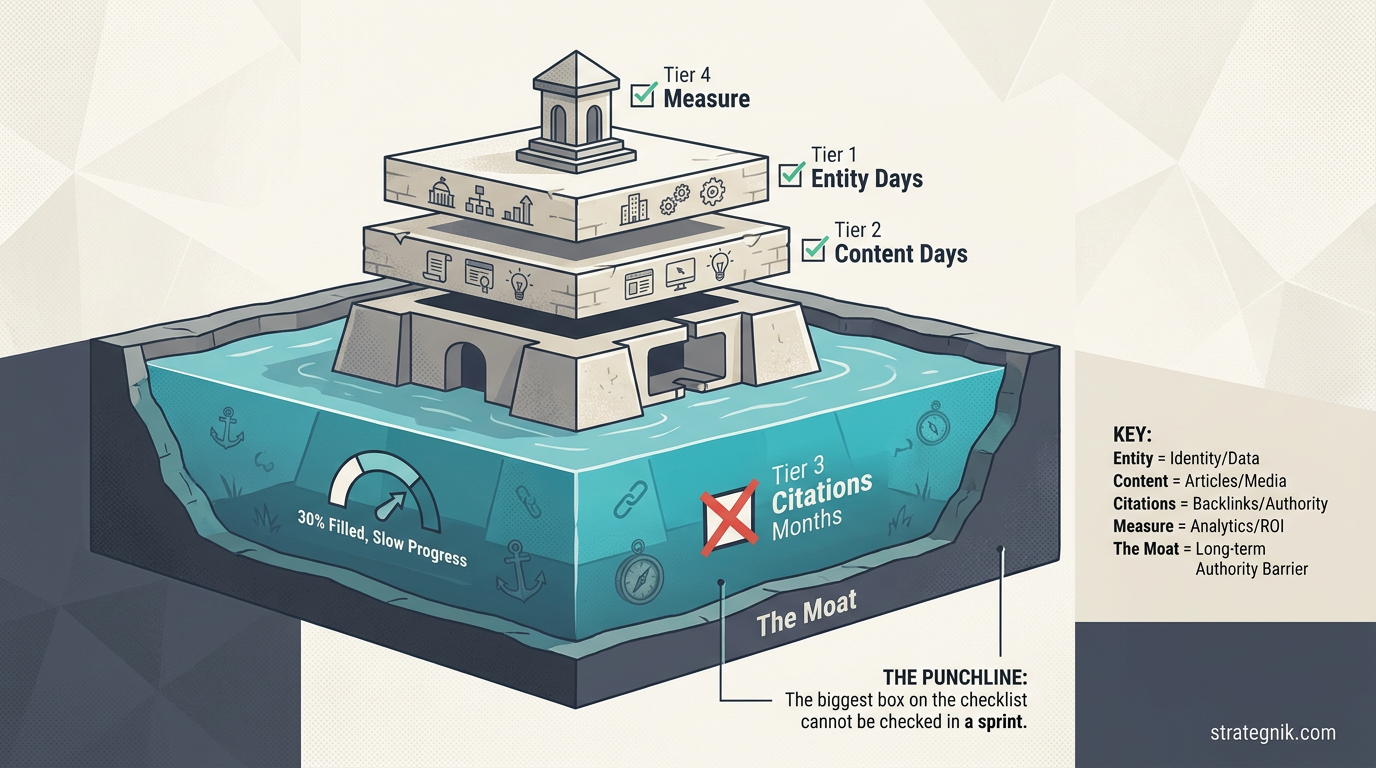
One honest framing before the list. Tiers 1 and 2 are days of work. A competent marketer with dev support can clear them in a sprint or two. Tier 3 is the months-long compounding work that determines whether AI engines ever name you, and it’s where most companies quit. If you want the whole thing run with someone who does this every week instead of piecing it together from checklists, that’s what generative engine optimization services exist for. Either way, the sequence below is the sequence.
If you want the strategic case for why this discipline exists at all, the Answer Engine Optimization page covers it. This post is the execution list.
Tier 1: Entity Foundation
AI engines retrieve entities, not pages. Before any content work pays off, the machines need to know what your company is, what category it belongs to, and that every source describing it agrees. This tier is mostly configuration. Do it first because everything downstream depends on it.
1. Add Organization schema to your homepage. Include your legal name, logo, description, founding date, and sameAs links to every official profile. This is the machine-readable declaration of what your company is, and it takes a developer under an hour.
2. Write one canonical entity description and deploy it everywhere. Your homepage, LinkedIn, G2, Crunchbase, and every directory listing should describe the company in the same terms. AI systems triangulate identity across sources; conflicting descriptions read as low confidence, and low confidence means you get skipped.
3. Claim your Google Knowledge Panel. If one exists, verify it and correct it. If one doesn’t exist, treat that as a diagnostic: Google’s Knowledge Graph doesn’t recognize you as an entity yet, which predicts poorly for every other engine.
4. Standardize your name, address, and category language. Pick one company name format and one category phrase (“freight audit software,” not five variations) and enforce them across every surface. Category consistency is how engines decide which question you’re an answer to.
5. Publish an llms.txt file. This is an emerging convention: a markdown file at your root that summarizes your site for language models. Adoption by the major engines is unproven, and I’ve written about whether llms.txt actually works, but it costs an hour and the downside is zero. Do it last in this tier, not first.
Tier 2: Content Retrievability
Entity work tells engines what you are. This tier makes your content extractable when they go looking for answers. The pattern across all five items: AI retrieval pulls concise, direct passages, so structure every page as if a machine will quote 80 words of it. Because one will.
6. Answer the question in the first two sentences of every page. Not after the empathy paragraph, not after the “in a world where” setup. Lead with the answer, then support it. Pages that bury the answer get passed over for pages that don’t.
7. Rewrite your H2s as questions buyers actually ask. “How much does freight audit software cost?” beats “Pricing Considerations” because retrieval systems match headings against real query language. Pull the phrasings from sales calls and search data, not from what sounds polished.
8. Add FAQ schema to your service pages. Question-and-answer markup is the most directly extractable structure you can give a retrieval system. Write real answers, 40 to 80 words each, in the same language buyers use.
9. Enforce one page per intent. If three pages half-answer the same question, engines can’t tell which one is canonical and often cite none of them. Consolidate overlapping pages into a single authoritative one and redirect the rest.
10. Kill your thin pages. Tag archives, 200-word posts from 2021, orphaned landing pages. They dilute the site’s signal-to-noise ratio for anything crawling it. Delete, consolidate, or noindex.
Tier 3: Citation Surface
Tiers 1 and 2 make you retrievable, but AI engines mostly decide who belongs in an answer by consensus across third-party sources: review platforms, comparison articles, community threads, cited research. I’ve mapped where ChatGPT actually gets its answers, and the short version is that your own website is a minority input. In the Coherence Model, this tier is Mass work: building weight that other sources reference, which compounds for months and can’t be faked in a sprint. It is also the tier that separates companies that get cited from companies with clean schema and no mentions.
11. Get listed on the review platforms your category uses. G2, Capterra, TrustRadius, or whatever your buyers actually consult. Engines lean heavily on these for “best X” answers, and an absent profile is evidence you don’t belong in the category.
12. Earn placement in ranked listicles. When someone asks an AI engine for the best tools in your space, it synthesizes from existing “best X” roundups. Identify the ten that dominate your category’s results and do the unglamorous outreach to get included.
13. Publish original data worth citing. A benchmark report, a survey, an analysis of your own platform data. Other sites cite data, engines follow citations, and one genuinely useful dataset outperforms fifty opinion posts.
14. Name your frameworks. A named methodology is a retrievable entity; an unnamed process is a paragraph nobody can reference. If you have a real point of view on how your problem should be solved, give it a name and defend it consistently.
15. Build a legitimate presence where your category gets discussed. For most B2B categories that means Reddit, plus industry Slacks and forums. Community threads feed AI training and retrieval, but astroturfing gets detected and torched, so this means actual participation over months. Slow is the point.
Tier 4: Measure and Iterate
You can’t manage what you never baseline, and AI visibility is noisy enough that unmeasured GEO work turns into faith-based marketing. None of this requires paid generative engine optimization tools to start. A spreadsheet and a repeatable prompt set will carry you further than a dashboard you check twice.
16. Baseline your AI visibility before touching anything else. Run a structured set of buyer-realistic prompts across ChatGPT, Perplexity, and AI Overviews, and record who gets named. The free AI visibility grader automates a first pass if you’d rather not build the prompt set yourself.
17. Track mention rate monthly. Same prompts, same engines, same cadence. The metric is simple: in what percentage of category-relevant answers does your company appear?
18. Monitor which sources power competitor mentions. When an engine cites a competitor, note the underlying source. That’s your Tier 3 target list, written for you by the machine you’re trying to influence.
19. Re-test after each fix batch. Ship Tier 1, measure. Ship Tier 2, measure. Attribution stays impossible if you change everything at once and check once a quarter.
20. Treat variance as noise and trends as signal. The same prompt returns different answers on different days; that’s how these systems work. A single dropped mention means nothing. Three months of declining mention rate means everything.
Where to Start
Do Tier 1 this week. It’s cheap, fast, and foundational, and there’s no defensible reason a B2B company should still have inconsistent entity signals in 2026. Do Tier 2 over the next month as you touch each core page. Run item 16 before either, so you can prove the work did something.
But don’t confuse finishing the fast tiers with doing GEO. Schema and answer-first structure are table stakes that your competitors will also complete, probably this year. Tier 3 is the moat, because citation surface takes months to build and months for anyone else to replicate, and the engines reward accumulated third-party evidence over on-site polish every time. The companies winning AI citations in your category two years from now started their Mass work early and kept going after the checklist stopped feeling productive. Start the compounding work now, measure it monthly, and let everyone else stop at schema.