ChatGPT gets its answers from two places: the knowledge baked into the model during training, and live web retrieval that runs through Bing’s index when you ask something current. If you want your company in those answers, you need to know which sources feed both layers, because it’s almost never your website.
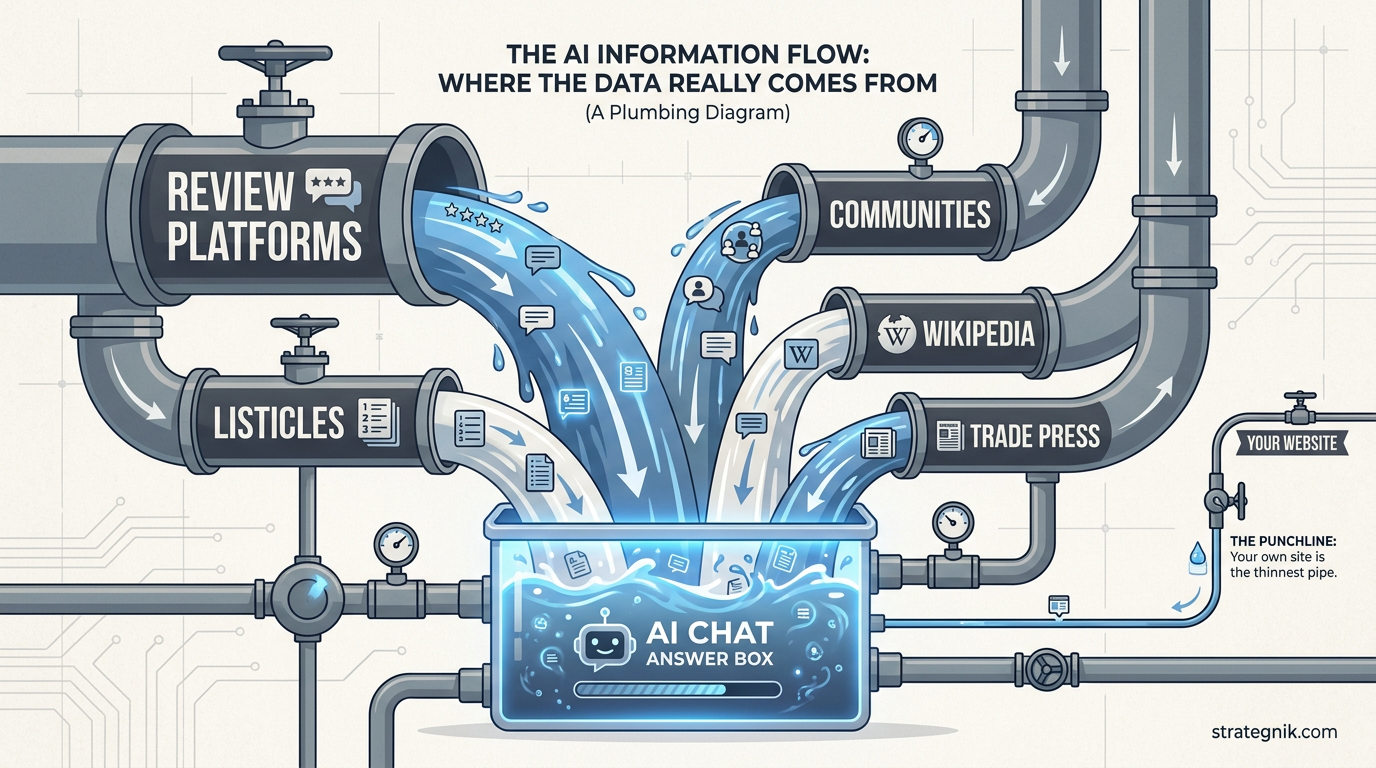
That last part is what most B2B marketing teams miss. They optimize their own domain while the AI builds its answer from G2, Reddit, Wikipedia, and someone else’s listicle.
Where Does ChatGPT Get Its Information?
Path one is parametric knowledge. During training, the model ingests web-scale crawl snapshots plus licensed content, and that material gets compressed into the model’s weights. OpenAI has signed content deals with Reddit, Axel Springer, News Corp, and the Financial Times, among others. Wikipedia is heavily represented in training data across every major model. When ChatGPT answers without searching, it’s drawing on this layer: a statistical memory of what those sources said, frozen at the training cutoff.
Path two is live retrieval. When ChatGPT search kicks in, it retrieves current pages through Bing’s index, reads them, and synthesizes an answer with citations. This is why Bing indexing suddenly matters again after a decade of nobody caring. If Bing hasn’t indexed your page, ChatGPT search can’t retrieve it, full stop.
Other engines run their own stacks. Perplexity built its own retrieval infrastructure. Gemini pulls from Google’s index. Same two-layer architecture, different plumbing.
The strategic implication: you’re playing two games at once. The training-data game is slow. It rewards presence in sources that get crawled and licensed, and it compounds over years. The retrieval game is faster. It rewards pages that are indexed, structured, and answer-shaped today. Most companies are losing both without knowing either exists.
What Sources Do AI Engines Cite for Vendor Questions?
Here’s where it gets uncomfortable for anyone whose AI strategy is “improve our website.” For commercial queries, the “best X for Y” and “which vendor should I pick” questions your buyers actually ask, AI answers lean heavily on third-party sources. In the citation audits I run for B2B clients, the same source mix shows up over and over:
Review platforms. G2 and Capterra profiles, category pages, and comparison pages get cited constantly. These platforms have structured data, dense entity signals, and thousands of pages mapping vendors to categories. To an AI engine, a G2 category page is a pre-built answer.
Comparison listicles. “Best CRM for mid-market SaaS” posts on domains that already rank. When a model needs to answer a best-of question, an existing best-of article is the lowest-friction source available. The listicle’s author just became your gatekeeper.
Reddit threads. OpenAI licenses Reddit content directly, and retrieval systems surface Reddit for almost any “what do people actually use” question. Practitioner threads read as unfiltered peer opinion, which is exactly what a model wants when synthesizing a recommendation.
Wikipedia. For entity-level facts, what your company is, what category it’s in, who founded it, Wikipedia remains the backbone. If your company has a page, models treat it as ground truth.
Industry publications. Trade press, analyst coverage, and established niche blogs carry authority in their domains. A mention in a respected logistics publication does more for a freight-tech vendor’s AI visibility than ten posts on the vendor’s own blog.
Notice what’s barely on the list. Vendor websites get cited for facts about the vendor itself, pricing, features, docs. For the question that decides deals, “which one should I buy,” your own site is a minority source.
Why Do AI Answers Favor Third-Party Sources?
Because third-party validation beats self-description, and the models are built to know the difference.
Every vendor’s website says the vendor is the leader. That’s not information; it’s noise with a logo. A model trained to produce trustworthy recommendations learns to weight sources that evaluate vendors over sources that are vendors. A review platform aggregating 400 customer opinions, a subreddit arguing about real deployments, an editor who ranked twelve tools: these carry evidentiary weight your homepage can’t.
This mirrors how a smart human buys. Nobody’s final diligence step is reading the vendor’s About page. They ask peers, check reviews, read comparisons. AI engines have operationalized that instinct at scale. I covered why this makes Google rankings a poor predictor of AI visibility in why you can rank on Google and still be invisible in ChatGPT; the short version is that the source graph AI trusts and the link graph Google ranks are different graphs.
How Do You Earn Presence in Each Source Type?
Each source type has a distinct playbook. Treat them as separate workstreams, not one “AI SEO” bucket.
Review platforms: build the profile, then drive volume. Claim and complete your G2 and Capterra profiles with the exact category language you want AI engines to associate with you. Then run a systematic review-generation motion, because review count and recency affect whether you appear on the category and comparison pages models cite. A profile with nine stale reviews signals a vendor nobody uses.
Listicles: get into the articles that already rank. Find the “best X” posts that show up for your category and pitch inclusion. Some accept updates on merit, some want a relationship, some are pay-to-play. Evaluate each on its terms. Earning a slot in an established roundup is usually faster than trying to outrank it, and once you’re in, every AI engine citing that page inherits your presence.
Reddit: participate legitimately or stay out. Astroturfing gets detected, by moderators and increasingly by the models themselves, and it burns trust you can’t rebuild. What works is founders and practitioners answering questions in their actual domain of expertise, disclosed and useful. One genuinely helpful comment thread where your product comes up naturally is worth more than fifty planted mentions, and it doesn’t blow up in your face.
Wikipedia and industry press: this is digital PR. You can’t write your own Wikipedia page into legitimacy; notability comes from independent coverage. So work the causality in the right order. Original research, data reports, and expert commentary earn trade-press coverage. Trade-press coverage builds the citation base that makes a Wikipedia presence defensible and makes industry publications reference you unprompted.
One caveat: don’t abandon your own site. It still owns the vendor-fact layer, and structuring it for retrieval matters. That’s a separate discipline I break down in how to get recommended by ChatGPT.
Do All AI Engines Cite the Same Sources?
No, and this trips up teams who spot-check ChatGPT and call it a day. ChatGPT retrieves through Bing, so Bing indexing and Bing-visible authority shape its citations. Perplexity’s independent retrieval stack surfaces a different mix, typically heavier on recent web content. Gemini inherits Google’s index and its quality signals, so it correlates more with traditional Google visibility than the others do.
A company can be well-cited in Perplexity and absent from ChatGPT, or vice versa. Check all the engines your buyers use, and check on a recurring basis rather than once, because answers drift as indexes and models update. Doing this manually gets old fast; I’ve reviewed the monitoring platforms that track citations across engines in my rundown of GEO and AEO tools.
What This Means for Your GTM Strategy
Stop thinking of AI visibility as a content problem on your domain. It’s citation-graph work: systematically building presence in the sources models already trust, so that when an engine assembles an answer about your category, the evidence for including you is everywhere it looks.
In Coherence Model terms, this is Mass. Every review, every listicle placement, every legitimate community mention, every piece of earned coverage adds weight to your entity in the exact places AI systems measure it. And unlike paid channels, it compounds. Sources cite sources; a trade-press mention feeds a Wikipedia citation feeds a training corpus. The vendors getting recommended by ChatGPT today started accumulating that mass two years ago.
If you don’t know where you stand across these source types, that’s the first diagnostic to run, and it’s exactly what a structured GEO engagement starts with. Map your presence in the citation graph, find the gaps against the competitors AI already names, and work the source types in order of leverage.
Frequently Asked Questions
Where does ChatGPT get its information? From two layers. First, training data: web-scale crawl snapshots plus licensed content from partners including Reddit, Axel Springer, News Corp, and the Financial Times, with Wikipedia heavily represented. Second, live retrieval: when ChatGPT search runs, it pulls current pages through Bing’s index and cites them. Older or general-knowledge answers come from the training layer; current-events and product-comparison answers usually involve retrieval.
What sources does ChatGPT cite for “best software” questions? Predominantly third-party sources: review platforms like G2 and Capterra, comparison listicles on established domains, Reddit threads, Wikipedia, and industry publications. Vendor websites get cited for facts about the vendor itself but rarely drive the recommendation. In my own citation testing across B2B categories, third-party sources consistently outweigh vendor-owned pages for commercial queries.
Why does ChatGPT mention my competitor but not my company? The model has third-party evidence for your competitor and not for you. If they appear in review-site categories, ranked listicles, community threads, and press coverage while you don’t, the engine has reason to include them and none to include you. It’s a citation-graph gap, not a product-quality judgment, and closing it means earning presence in those same sources.
Does being indexed by Bing matter for ChatGPT visibility? Yes. ChatGPT search retrieves through Bing’s index, so a page Bing hasn’t indexed can’t be retrieved or cited in a search-augmented answer. Verify your site in Bing Webmaster Tools and confirm your key pages are indexed. It won’t fix a weak citation graph, but it’s a hard prerequisite for the retrieval layer.
Do Perplexity and Gemini use the same sources as ChatGPT? No. Perplexity runs its own retrieval stack and tends to surface a different, often more recent source mix. Gemini pulls from Google’s index, so it correlates more closely with traditional Google visibility. The same query can produce different vendor lists across engines, which is why monitoring only ChatGPT gives you an incomplete read.