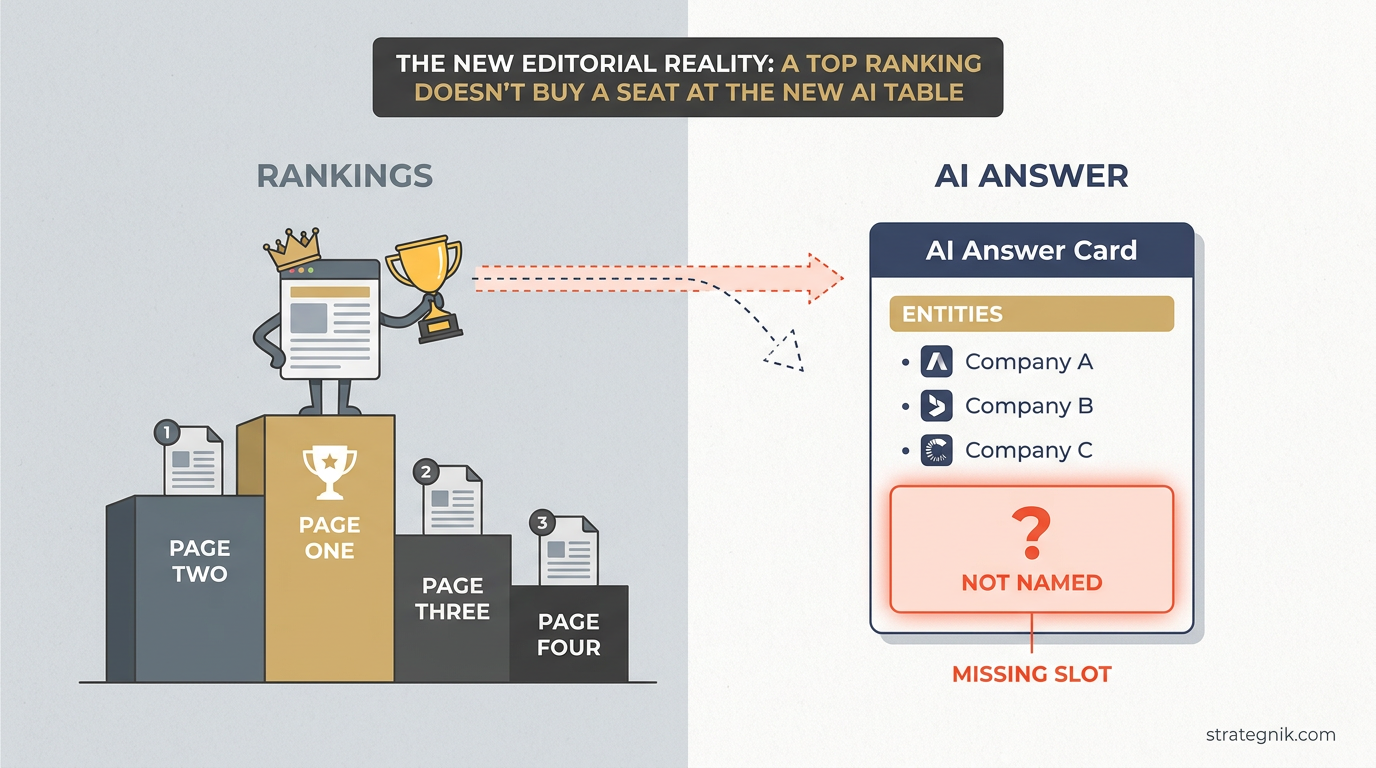
Your Google ranking measures how much Google trusts your pages. A ChatGPT recommendation measures how much the model trusts your company as an entity, and the two systems share almost no scoring criteria. That’s why you can sit on page one for your category keyword and never once appear when a buyer asks ChatGPT who they should evaluate.
This post is the diagnosis. If you want the fix playbook, that’s a separate piece: how to get recommended by ChatGPT. Here I want to walk through the mechanism, because until you understand why the systems diverge, every fix you attempt will be SEO tactics wearing a new hat.
We Rank Well on Google but Are Invisible in ChatGPT. Why?
Because you earned the wrong kind of authority for this channel. A page-one Google ranking is the output of a system that evaluates pages: links pointing at a URL, relevance signals on that URL, engagement with that URL. You built URL equity, and you built a lot of it.
An LLM answering “what’s the best freight audit platform” isn’t ranking URLs. It’s assembling a shortlist of companies from what it learned in training and what it retrieves at answer time, then synthesizing a recommendation. The unit of competition is the entity, not the page. If the model doesn’t have a clear, well-corroborated concept of your company, your beautifully optimized pages are inventory in a warehouse the buyer never enters.
This is the single most common disconnect I see in AI visibility work right now. Marketing teams read their Search Console data, see healthy rankings, and assume the AI channel is covered. Then they ask ChatGPT the exact question their pipeline depends on and watch it name three competitors. The ranking was real. It just measured something else.
How Does ChatGPT Actually Answer “Who Should We Use” Questions?
Two mechanisms, and your SEO program barely touches either one.
The first is parametric knowledge: what the model absorbed during training. When someone asks a recommendation question with browsing off, the answer comes entirely from this baked-in memory. If your company appeared consistently across the training corpus in comparison articles, community threads, industry coverage, then you exist in that memory. If your presence was mostly your own domain, you’re thin. One well-ranked website is a rounding error inside a corpus that size.
The second is retrieval. ChatGPT’s search mode pulls live results, and it does so through Bing’s index, not Google’s. Right away, some of your Google-specific equity doesn’t carry. But the bigger issue is what happens after retrieval: the model reads a small handful of sources and synthesizes one answer from them. There is no page two. There isn’t even a page one in any meaningful sense. There’s a source set of maybe a half-dozen documents, and everything else is invisible.
And watch which sources make that cut. In my own testing across B2B categories, the citations skew heavily toward third parties: review platforms, comparison listicles, Reddit threads, Wikipedia, industry publications. Vendor sites appear far less often than their Google rankings would predict. It’s worth noting OpenAI has content deals with Reddit and major publishers, which tells you where they believe answer-quality lives. I break down the full source landscape in where ChatGPT gets its answers.
Why Won’t ChatGPT Cite My Own Website?
Because for recommendation questions, you are a structurally biased source, and the system treats you that way.
Think about what your category page actually says: you, describing why you’re the best choice. Every vendor’s page says the same thing about themselves. A synthesis engine trying to produce a trustworthy answer to “who should I use” gets nothing decision-useful from any of them, so it reaches for third-party validation instead. The G2 category. The analyst roundup. The Reddit thread where a practitioner with no stake in the outcome says “we switched to X and it actually worked.”
This is the part that stings for teams with strong SEO programs. Your comparison page might outrank the listicle that ChatGPT cites. Doesn’t matter. For “best X” and “who should I use” queries, the listicle is evidence and your page is a claim. The model weights evidence.
Your own site still matters, but its job changes. It’s no longer the destination that wins the click. It’s the canonical reference that confirms what the third-party sources say about you, and the place retrieval systems go to extract clean facts about what you do. Which most B2B sites are terrible at, and that’s the next problem.
Why Does Keyword-Shaped Content Fail AI Retrieval?
Because it was engineered to win a ranking auction, not to be quoted.
A decade of SEO practice produced a very specific content shape: 2,000 words targeting a keyword, a slow wind-up intro, the actual answer diffused across twelve H2s so the page can rank for forty variants. That shape worked because Google rewarded comprehensiveness and dwell time. A human would scroll. A crawler would index the whole thing.
Retrieval systems don’t consume pages that way. They extract passages, and they favor passages that directly and completely answer the question in compact form. A page where the answer is smeared across 2,000 words offers no single extractable passage. The system grabs a cleaner one from somewhere else, often from a site with a fraction of your domain authority, because that page said the thing plainly in two sentences.
So the content that made you rank is, passage by passage, some of the least retrievable material in your category. Nobody made an error here. You optimized correctly for the old scoring function. The scoring function changed.
Does the Model Even Know What Your Company Is?
Often, no. Not crisply. And this is the entity problem underneath everything else.
Run the audit yourself. Read how your company is described on your homepage, your LinkedIn page, your G2 profile, your Crunchbase entry, your founder’s bio, and the last three press mentions. In most B2B companies I audit, those are six different descriptions. Different category language, different positioning, sometimes descriptions from two pivots ago still live on high-authority third-party pages.
An LLM builds its concept of your company by triangulating across all of those sources. When they agree, you get a sharp entity the model can confidently place in a category and recommend. When they conflict, you get a blur. And a model won’t stake a recommendation on a blur; it names the competitor whose signals resolve cleanly instead. In Coherence Model terms, this is Mass failing to cohere: plenty of raw material about you exists in the corpus, but it’s out of phase with itself, so it never compounds into an entity the model trusts.
Google was forgiving of this inconsistency because it ranked your pages on their own merits. LLMs are not, because the entity is the product.
What Transfers From SEO, and What Doesn’t?
Your Google authority is not worthless. It’s necessary and insufficient, and it’s worth being precise about which is which.
What transfers: domain authority correlates with being treated as a credible source when your pages do get retrieved. Crawlability and site structure transfer, since retrieval still requires fetching your content. Structured data transfers. And the discipline of earning links transfers, because links are one of the corroboration signals that build entity confidence.
What doesn’t: keyword rankings as a scoreboard. Page-level optimization as the unit of work. Content volume as a strategy. And critically, the assumption that your own domain is where the battle happens. In AI answers, most of the surface area that decides whether you get recommended lives on properties you don’t control.
The context matters here. SparkToro’s zero-click research found the majority of Google searches already end without a click to the open web, and Gartner projects a 25% decline in traditional search volume as buyers move research into AI tools. The channel you’re winning is shrinking while the channel you’re invisible in absorbs its traffic.
Here’s my actual position. The teams treating this as “SEO with extra steps” are going to lose two years relearning it, because the mental model is wrong at the root: one system ranks pages, the other recommends entities, and tactics built for the first quietly fail in the second. The teams that win will be the ones that reallocate effort from their own domain to the third-party surfaces where models form their opinions, and who make their company legible as an entity before worrying about any individual page. If you want to know where you stand today, run your company through the AI visibility grader, then take the results to the fix playbook. Diagnosis first, though. It changes what you build.